
Blog

Turning Your Creative Work into a Business in Contemporary Nigeria: IP as a Revenue Stream.

Introduction

In an era increasingly defined by intangible assets, intellectual property (IP) has emerged as a potent economic resource for creators across Nigeria. While talent and originality remain central to creative success, monetisation through structured legal and business frameworks is what transforms creativity into sustainable enterprise. For Nigerian artists, writers, musicians, filmmakers, and digital innovators, understanding how to commercialise IP is not merely a luxury—it is a necessity in an economy where informal sectors dominate and rights enforcement remains underdeveloped.

This article explores how creators in contemporary Nigeria can turn their works into viable business ventures, focusing on licensing, franchising, merchandising, and relevant tax considerations. Drawing on Nigerian legal principles and international best practices, it offers a practical and analytical approach to unlocking the value inherent in creative works.

The Nature of Intellectual Property as a Commercial Asset

Intellectual property refers to creations of the mind—such as literary and artistic works, designs, symbols, names, and inventions—that are protected by law. In Nigeria, the principal statutes governing IP include the Copyright Act 2022, the Patents and Designs Act 1970, and the Trademarks Act 1965. Under these frameworks, IP rights confer exclusive control to the rights holder, enabling them to license, assign, or otherwise exploit these assets for profit.

The transformation of creative output into a business begins with recognising IP as not just a legal entitlement, but a commercial tool. For example, a musician owns copyright in their composition and recording; these rights can be fragmented and monetised through performance rights organisations, streaming deals, or licensing for commercials. Similarly, a visual artist’s brand can be developed into a merchandising line OR even a novelist’s character universe ie collection of fictional characters, settings, storylines, and themes created in a book or series, can be licensed to film studios or game developers.

Yet, commercialisation requires more than ownership—it requires strategy. The creator must understand market value, legal protections, enforceability, and the infrastructure to manage and monetise their IP.

Licensing: Leveraging Control While Retaining Ownership

Licensing is one of the most effective ways to monetise IP in Nigeria. A licence is a contractual agreement by which the rights holder (licensor) permits another party (licensee) to use their intellectual property for a defined purpose, in a specific territory, and for a certain duration. The Copyright Act 2022 affirms the right of authors to grant licences for reproduction, adaptation, performance, broadcasting and other uses of their works, either exclusively or non-exclusively.

A well-drafted licence agreement enables the creator to earn recurring income while maintaining ownership. In Nigeria’s music industry, for instance, mechanical licences permit streaming platforms like Boomplay or Spotify to use artists’ recordings. In publishing, authors license their works to publishers in exchange for royalties. In the digital space, developers often license their software under open-source or commercial terms.

However, licensing requires attention to detail. Key clauses should cover the scope of use, payment structure (flat fee, royalty, or hybrid), duration, termination rights, indemnity, and dispute resolution.

A clearer instance of licensing within the Nigerian creative or tech ecosystem can be found in the licensing of digital content services by the Nigerian Copyright Commission (NCC). For example, platforms like iROKOtv and YouTube partners (Nigerian channels officially monetising content) typically enter into licensing agreements with rights holders (such as Nollywood producers) to host and monetise films.

These agreements are often registered with the NCC to ensure enforceability and public record, especially when disputes arise over revenue-sharing or piracy. Registration is strongly recommended in cases of exclusive or high-value licences.

Registration Process through the Nigerian Copyright Commission (NCC):

  1. Submission of the Licensing Agreement: The rights owner (licensor) or their lawyer submits the licence agreement to the NCC, stating whether it is exclusive or non-exclusive.
  2. Accompanying Forms and Documents: Includes the NCC’s standard registration form, a statutory declaration, and proof of ownership (e.g., copyright registration certificate or assignment document).
  3. Payment of Filing Fees: A modest fee is paid depending on the category and scope of the licence.
  4. Review and Entry into Register: The NCC reviews the submission to ensure compliance with the Copyright Act 2022 and, if approved, enters it into the official register of copyright transactions.

This process does not create the licence but provides legal certainty and public notice of the transaction. It is particularly useful where disputes over exclusivity, scope, or territorial use might arise

Moreover, for international deals, Nigerian creators must consider jurisdictional issues and the protection afforded under treaties such as the Berne Convention and TRIPS Agreement.

A notable example of jurisdictional and treaty-based protection is the case of Nollywood films licensed for global streaming on Netflix. When Nigerian producers license their content to Netflix (a U.S.-based company), the licensing agreement typically includes jurisdictional clauses that govern where and how disputes will be resolved — often stipulating New York or California law, or international arbitration.

In such cross-border deals, Nigerian creators must ensure that their copyrighted works are protected not only in Nigeria but also internationally. This is where international treaties come into play based on the following facts:

  • Nigeria is a signatory to the Berne Convention for the Protection of Literary and Artistic Works, which mandates that Nigerian creators enjoy automatic copyright protection in all other Berne member countries (currently over 180 countries), without the need for further registration.
  • Additionally, under the TRIPS Agreement (Agreement on Trade-Related Aspects of Intellectual Property Rights), to which Nigeria is also a party via its WTO membership, Nigerian works receive enforceable IP protection standards in other WTO member countries. TRIPS also sets minimum enforcement obligations and dispute resolution processes that can be relied upon in international litigation or arbitration.

In 2020, Mo Abudu’s EbonyLife Studios entered a multi-title content partnership with Netflix, the IP involved (films, series concepts, character rights), which were protected internationally under both the Berne Convention and TRIPS, ensuring EbonyLife’s rights remained enforceable in the U.S., UK, and other Netflix territories

Franchising: Replicating Creative Business Models

Franchising offers a strategic pathway for Nigerian creatives who wish to scale their brand and business operations without directly managing every outlet. In legal and commercial terms, franchising is a model through which a creator or brand owner (the franchisor) permits another party (the franchisee) to operate a business using the franchisor’s brand, trade secrets, and other intellectual property under specified conditions.

Although Nigeria does not currently have a specific franchise law, the legal architecture governing franchising is built on multiple intersecting frameworks. The most fundamental of these is contract law. Since franchising is a contractual relationship at its core, the Nigerian Law of Contract governs the franchise agreement. The agreement must be legally valid—i.e., based on offer, acceptance, consideration, and an intention to create legal relations. It must also clearly outline the scope of the franchise i.e territorial boundaries, obligations of the franchisor and franchisee, quality control expectations, duration, renewal terms, and conditions for termination. Vague or incomplete agreements expose both parties to operational and legal risks, including disputes over revenue-sharing, branding, or performance.

Intellectual property law, particularly the Trade Marks Act, plays a central role in franchising, as it protects the creative assets that form the foundation of the franchise. A creative entrepreneur must register their brand name, logos, slogans, and related marks with the Trademark Registry to ensure enforceability and exclusivity. The franchisee is then licensed to use these marks under controlled conditions. Without such protection, the franchisor may lose the ability to restrict unauthorised use, leading to brand dilution or reputational damage.

Franchise arrangements must also be examined through the lens of competition law. The Federal Competition and Consumer Protection Commission Act 2018 prohibits agreements that may substantially restrict competition or create monopolistic control. Clauses in franchise agreements that engage in price-fixing, exclusive dealing, or territorial restrictions must be carefully evaluated to avoid contravening anti-competitive practice provisions under the oversight of the Federal Competition and Consumer Protection Commission (FCCPC). While some restrictions may be justifiable for brand consistency or quality control, overly broad or oppressive terms may invite regulatory scrutiny.

Furthermore, franchising arrangements must comply with Nigeria’s consumer protection laws, also administered by the FCCPC, ensuring that the rights of end consumers are upheld, regardless of whether they are dealing with the franchisor or franchisee. Issues such as false advertising, misleading promotional materials, product safety, and fair refund policies fall within the FCCPC regulatory purview. Failure to uphold these standards can result in penalties, sanctions, or reputational damage, all of which may undermine the long-term viability of the franchise system.

In practice, creative entrepreneurs can adopt franchising to replicate successful business models in fashion, food, entertainment, or lifestyle branding. A designer with a successful boutique in Lagos, for instance, may enter into franchise agreements to expand into Abuja, Port Harcourt, or even across West Africa, provided the underlying IP is protected and regulatory compliance is ensured.

While franchising offers tremendous growth potential, it demands strategic planning and robust legal infrastructure. Prospective franchisors must work closely with IP lawyers, tax advisors, and business consultants to ensure that the franchise model is scalable, legally compliant, and aligned with long-term business goals

Merchandising: Materialising Creative Expression

Merchandising involves the commercial use of characters, images, logos, or phrases from a creative work on physical goods. It allows creators to monetise fan engagement and cultural capital. For example, a popular comic book character can appear on clothing, mugs, posters, and even video games—each representing a separate revenue stream.

A global case study in merchandising excellence is Barbie, the iconic doll brand owned by Mattel Inc. Since its launch in 1959, Barbie has evolved from a toy into a multi-billion-dollar lifestyle brand. The company has licensed Barbie’s image, logo, and characters across a vast range of products — from backpacks and lunchboxes to video games, cosmetics, animated films, and most recently, the 2023 Barbie live-action movie. That film alone drove over $1.4 billion in global box office revenue, while also triggering a fresh wave of merchandise sales in apparel, beauty, and home decor, co-branded with leading global retailers.

This model of IP commercialisation demonstrates the power of character-based branding. Barbie’s pink-themed aesthetic, distinct typography, and cultural influence have been licensed to hundreds of manufacturers globally. Each merchandising deal is underpinned by formal IP licensing agreements, often registered in accordance with national laws and protected under international treaties such as the Berne Convention and TRIPS.

For Nigerian creators, this offers a replicable blueprint. A comic artist or author can license characters for school supplies, clothing lines, or animated web series. Music artists can monetise their brands through fashion lines or branded accessories. But these activities must be governed by well-structured licensing contracts to ensure that royalty rates, production quality, brand consistency, and territorial rights are clearly defined — and enforced where necessary.

Merchandising, when backed by a strong IP strategy, allows a brand to transition from creative expression to commercial empire, a model that Barbie has arguably perfected over six decades.

The commercial success of merchandising depends heavily on branding and marketing. Nollywood films, for instance, have begun exploring merchandise extensions, such as T-shirts bearing iconic quotes or character imagery. Similarly, music artists may sell branded merchandise during concerts or online, extending the lifecycle and reach of their creative works like Beyoncé is currently doing at the Cowboy Carter Tour.

Importantly, creators must monitor and enforce their IP rights to avoid unauthorised use or counterfeit merchandise, a common problem in Nigeria’s informal markets. Partnering with established retailers, using digital sales platforms, and entering joint ventures can reduce operational burdens while ensuring professional distribution.

Tax and Regulatory Considerations

Transforming creative work into a business also entails compliance with Nigeria’s tax and regulatory framework. IP-generated revenue—whether through royalties, franchise fees, or merchandise sales—is subject to taxation under Nigerian law.

The Federal Inland Revenue Service (FIRS) treats income from licensing or royalties as part of a taxpayer’s assessable income under the Personal Income Tax Act 2011 or the Companies Income Tax Act 2007, depending on whether the rights holder is an individual or a corporate entity. In some cases, withholding tax may be applicable on royalty payments, particularly in cross-border transactions.

Moreover, Value Added Tax (VAT) obligations may arise from the sale of merchandise or licensing of digital content. Section 2 of the VAT Act 2007 (as amended) imposes VAT on the supply of goods and services in Nigeria, including intangible assets such as software or artistic content.

To reduce tax exposure and ensure compliance, creators should consider formalising their businesses through business name registration or incorporation under the Corporate Affairs Commission (CAC). This not only enhances credibility but also facilitates access to bank loans, grants, and investor funding.

In some instances, creators may benefit from tax incentives, such as the Pioneer Status Incentive for creative sectors or specific waivers granted by the Nigerian Export Promotion Council (NEPC) for export-oriented creative goods. Legal and tax advisors play a crucial role in helping creatives navigate these complexities.

Challenges and Opportunities in the Nigerian Context

While the potential to monetise IP is considerable, Nigerian creatives face systemic barriers that can inhibit revenue generation. These include weak enforcement of IP laws, piracy, lack of access to legal counsel, limited financial literacy, and inadequate government support. Despite the Copyright Act 2022 introducing stronger provisions for digital enforcement and recognition of new rights, implementation remains a challenge.

However, digital platforms have created new frontiers for IP monetisation. Social media, streaming services, e-commerce, and blockchain technologies offer Nigerian creators global exposure and direct-to-consumer models. The increasing interest of international investors and the growth of the African Continental Free Trade Area (AfCFTA) present new opportunities for regional and global licensing of Nigerian content.

To fully realise these opportunities, creators must invest in IP education, form partnerships with professionals, and adopt a business mindset. This includes maintaining documentation of ownership, using contracts in all commercial dealings, and taking advantage of registration systems offered by regulatory agencies like the Nigerian Copyright Commission (NCC), the Trademarks Registry, and the CAC.

Conclusion

In contemporary Nigeria, turning creative work into a business is no longer aspirational—it is both practical and necessary. Intellectual property offers a suite of tools that enable creators to generate revenue, build brands, and scale their impact. Licensing, franchising, and merchandising serve as powerful commercialisation strategies, while proper attention to tax and regulatory issues ensures legal and financial sustainability.

For Nigeria to fully unlock the potential of its creative economy, institutional support must be complemented by creator-driven action. Creatives who recognise their work as a business, and treat their IP as a core asset, are best positioned to thrive in an increasingly competitive and globalised market.

Written by Adeola Osifeko LLB, LLM, ACIS, ABR. Partner Corporate Commercial Group at AEO Law Practice.


References

  1. Copyright Act 2022 (Nigeria)
  2. Trademarks Act Cap T13, LFN 2004
  3. Patents and Designs Act Cap P2, LFN 2004
  4. Companies and Allied Matters Act 2020 (Nigeria)
  5. Thomas Buckley and Bloomberg, ‘Barbie doll sales boom for Mattel after the namesake’s movie became a global blockbuster’ Fortune 2023 https://fortune.com/2023/10/25/barbie-sales-mattel-movie-film-doll/ Accessed 17 May 2025
  6. Personal Income Tax Act Cap P8, LFN 2011 (Also see Chijioke Uwaegbute, and Emuesiri  Agbeyi, ‘Individual – Taxes on personal income’ PWC Tax Summaries 2025 <https://taxsummaries.pwc.com/nigeria/individual/taxes-on-personal-income> Accessed 16 May 2025
  7. Companies Income Tax Act Cap C21, LFN 2007 <https://old.firs.gov.ng/wp-content/uploads/2021/07/Company-Income-Tax-Act.pdf >
  8. Value Added Tax Act Cap V1, LFN 2007 (as amended)  <https://www.firs.gov.ng/vat>
  9. World Intellectual Property Organization (WIPO), Understanding Copyright and Related Rights (2nd edn, 2016) https://www.wipo.int/edocs/pubdocs/en/wipo_pub_909_2016.pdf Accessed 14 May 2025
Assessing the Competition & Consumer Protection Tribunal’s Judgment in Meta Platforms Inc/Whatsapp LLC v FCCPC.

Did the Judgment Address the Evidentiary and Interpretational Challenges in Nigeria’s Data Protection Enforcement?

The increasing integration of digital platforms into everyday life has raised substantial concerns about the intersection of data protection and competition law. Globally, regulators are grappling with the challenges of ensuring data privacy while also maintaining fair competition in digital markets. This dual objective is particularly pressing in jurisdictions where institutional and legislative frameworks are still evolving. Nigeria is one such jurisdiction, where the Federal Competition and Consumer Protection Commission (FCCPC) and the newly established Nigeria Data Protection Commission (NDPC) are asserting their authority to regulate tech giants such as Meta Platforms Inc. and WhatsApp LLC.

This article critically assesses the April 25, 2025 decision of the Competition and Consumer Protection Tribunal (the Tribunal) in the case of Meta v FCCPC, wherein the Tribunal upheld a $220 million fine imposed by the FCCPC for breaches of the Nigeria Data Protection Regulation (NDPR) 2019. The decision marks a turning point in Nigeria’s approach to data protection enforcement and reflects a broader trend toward regulatory assertiveness in digital markets. However, the judgment also raises important questions about the evidentiary and interpretational standards applied by the FCCPC and endorsed by the Tribunal.

Background to the Dispute.

The case against Meta arose from a 38-month joint investigation conducted by the FCCPC and the NITDA, which began in 2020. This investigation scrutinised the data collection and privacy practices of WhatsApp LLC and its parent company, Meta Platforms Inc. The FCCPC found that Meta’s business model relied on the excessive and unjustified collection of user data, including metadata beyond what was necessary for the delivery of WhatsApp services in Nigeria.

Following its findings, the FCCPC issued a Final Order on 19 July 2024, imposing a $220 million fine on Meta and WhatsApp for violating the Nigeria Data Protection Regulation (NDPR) 2019 and the Federal Competition and Consumer Protection Act (FCCPA) 2018. The Commission cited sections 17(a) and 104 of the FCCPA to justify its authority, stating that the data practices constituted ‘unscrupulous’ and ‘exploitative’ conduct in violation of consumer protection standards.

Meta and WhatsApp appealed the FCCPC’s Final Order to the Competition and Consumer Protection Tribunal, disputing both the jurisdictional authority of the FCCPC and the evidentiary basis of the Commission’s findings. The Tribunal, in a landmark judgment on 25 April 2025, upheld majority of the FCCPC’s determinations, including affirming the $220 million administrative penalty.

Interpretational Challenges: Data Minimisation and Consent Under the NDPR.

One of the central interpretational issues in Meta v. FCCPC, concerned the principle of data minimisation under the NDPR 2019. Article 2.1(1)(b) of the NDPR stipulates that personal data must be ‘adequate, accurate and without prejudice to the dignity of human person.’ The FCCPC interpreted this provision to mean that any personal data collected must be limited to what is strictly necessary to achieve the stated purpose. This concept aligns with the principle of data minimisation found in global data protection frameworks, such as Article 5(1)(c) of the GDPR.

The FCCPC’s analysis drew comparisons between WhatsApp and other messaging platforms like Signal and Telegram, noting that WhatsApp collected 44 distinct metadata points, whereas the latter collected only 4. However, the Commission failed to clearly articulate how each metadata point constituted personal data within the meaning of Article 1.3(xix) of the NDPR. This definitional gap raises significant evidentiary concerns.

Although the Commission relied on input from the National Information Technology Development Agency (NITDA), which confirmed that some data collected were not necessary for WhatsApp’s core functions, the FCCPC did not thoroughly analyse or categorise these data points. This lack of a granular assessment left open to question whether all the alleged excessive data points indeed fell foul of the NDPR.

Additionally, the FCCPC’s reliance on ‘consent’ as a remedial legal foundation, even for data that is not essential for service provision, seems to conflict with the broad applicability of the data minimisation principle. This is because consent cannot justify the collection of unnecessary data when the necessity principle is embedded in all legal grounds under the NDPR.

This interpretational ambiguity is expected to be clarified under the new Nigeria Data Protection Act (NDPA) 2023 and its General Application and Implementation Directive (GAID) 2025, which provides clear definitions for ‘adequate’, ‘relevant’, and ‘minimum necessary’ data. These clarifications aim to provide more robust evidentiary standards for future enforcement actions.

Jurisdictional Contest: FCCPC’s Mandate vs. NITDA’s Authority (Which has now Evolved Into NDPC’s Purview)

A core issue in Meta’s appeal was the jurisdictional competence of the FCCPC to adjudicate matters pertaining to data protection. Meta contended that the Nigeria Data Protection Regulation (NDPR) 2019 was issued by the National Information Technology Development Agency (NITDA), thereby vesting data protection oversight solely in NITDA’s purview.

The FCCPC, however, invoked Section 104 of the FCCPA 2018, which provides that “the Act shall override other laws on matters relating to competition and consumer protection”. Additionally, Section 17(a) empowers the FCCPC to enforce other enactments on consumer protection, an authority it relied on to treat NDPR violations as consumer harm.

The Tribunal, in addressing Issue 4 of the appeal, affirmed that the FCCPC acted within its statutory authority. It held that Section 104 of the FCCPA allows the Commission to regulate data practices that amount to exploitative or unfair conduct, even in sectors subject to regulation by other specialised agencies. By reinforcing this view, the Tribunal clarified the concurrent jurisdictional relationship between the FCCPC and other sector-specific regulators.

Although the Nigeria Data Protection Commission (NDPC) was formally established under the Nigeria Data Protection Act 2023 as the principal regulator of data protection, its operationalisation came after the events leading to the FCCPC’s investigation and order. The Tribunal therefore upheld the FCCPC’s jurisdiction without prejudice to the emerging role of the NDPC. This affirmation sets an important precedent, recognising that overlapping regulatory functions can coexist in a cooperative federal framework.

Nonetheless, the decision leaves unresolved how future inter-agency conflicts will be navigated, especially when both the FCCPC and the NDPC lay claim to enforcement authority over digital privacy matters. The GAID 2025 will likely necessitate a Memorandum of Understanding or similar legal instrument to clarify agency boundaries.

Evidentiary Weaknesses and the Standard of Proof.

One of the most significant criticisms of the FCCPC’s approach in Meta v FCCPC is the inadequacy of its evidentiary analysis, particularly in substantiating claims of excessive data collection under the NDPR. Although the Commission cited comparative statistics—such as WhatsApp’s collection of 44 metadata points versus Signal and Telegram’s collection of 4—it failed to convincingly establish that each of those metadata points constituted “personal data” as defined under Article 1.3(xix) of the NDPR 2019.

The NDPR defines personal data as any information relating to an identified or identifiable natural person. Thus, to assert a violation of data minimisation principles, the FCCPC bore the burden of demonstrating not only that data was collected, but that it was (i) personal in nature and (ii) unnecessary to the purpose of service delivery. In this regard, the Commission’s reliance on generalised comparisons, without technical analysis of the data points involved, fell short of the evidentiary standard required under Nigerian law. As the Nigerian courts have consistently held, he who asserts must prove.

Furthermore, the Commission’s determination that device fingerprinting involved excessive data collection is open to scrutiny. Device fingerprinting gathers technical details like browser settings or screen resolution, but the investigation report did not identify this as part of the actual metadata collected, nor did it adequately clarify its relevance to WhatsApp’s operational requirements in Nigeria.

The Commission also placed partial reliance on information from NITDA suggesting that some data collected was necessary while other data was optional or unnecessary. However, neither agency offered detailed classification nor provided a robust technical basis for this conclusion. This deficiency undermines the objective assessment of whether WhatsApp’s practices truly violated the requirement of adequacy under Article 2.1(1)(b) of the NDPR.

In this context, the evidentiary weaknesses in the FCCPC’s case exposed a critical gap in Nigeria’s enforcement framework. Future regulatory actions must be supported by detailed forensic analysis and independent technical assessments that can withstand appellate scrutiny. This is especially vital when dealing with sophisticated global tech entities capable of challenging enforcement actions on procedural and substantive grounds.

The Tribunal’s Reasoning: Deference or Diligence?

The Tribunal’s April 2025 judgment in Meta v FCCPC offers a rare window into judicial attitudes toward data protection enforcement in Nigeria. While the decision affirmed the FCCPC’s administrative fine and investigative processes, it left legal scholars/pundits questioning whether the Tribunal conducted a truly rigorous analysis or merely deferred to regulatory authority.

The Tribunal resolved all but one of the seven appeal issues in favour of the FCCPC. In Issue 3, for instance, Meta alleged a breach of fair hearing, claiming the Commission had not allowed sufficient opportunity to respond to the allegations. The Tribunal dismissed this, holding that the FCCPC had afforded Meta ample time to engage during the investigation and adjudication process. This finding underscores the recognition of the FCCPC’s quasi-judicial capacity and its compliance with the principles of natural justice.

In Issue 4, concerning jurisdiction, the Tribunal reaffirmed the FCCPC’s powers under section 104 of the FCCPA to override conflicting provisions of other laws on matters of consumer protection, even where other regulators are involved. This is a significant doctrinal endorsement that strengthens the FCCPC’s hand, especially in the absence of settled inter-agency coordination mechanisms.

Issue 5 was perhaps the most consequential in the context of data protection. It directly challenged the FCCPC’s conclusions regarding Meta’s privacy policies. The Tribunal held that there was no error in the Commission’s findings and that Meta’s policies indeed violated Nigerian law. However, the Tribunal offered limited elaboration on how it assessed the legality of the privacy policies. There was no detailed discussion of data minimisation or the contextual relevance of collected data. This suggests a deferential stance toward the FCCPC’s technical order, rather than an independent and probing review of the underlying data practices.

The Tribunal’s only substantive deviation came in Issue 7, where it set aside Order 7 of the Commission’s Final Order for lacking sufficient legal basis. Unfortunately, the decision did not explain the content of Order 7 in detail, nor did it clarify the threshold it applied to evaluate legal sufficiency. This omission leaves stakeholders guessing about the standards of review employed in data-related decisions.

Overall, while the Tribunal affirmed the regulatory direction Nigeria is taking, its decision arguably prioritised administrative compliance over substantive inquiry. Whether this approach can sustain long-term credibility for data protection enforcement remains to be seen. Judicial engagement with technical standards, contextual purpose, and proportionality is necessary if the Tribunal is to develop a jurisprudence fit for the data-driven economy.

Conclusion.

The Tribunal’s decision in Meta v FCCPC is a landmark precedence in Nigeria’s evolving data protection and digital competition jurisprudence. By upholding the FCCPC’s $220 million fine, cost of investigation at $35,000 and validating its jurisdiction under the FCCPA, the Tribunal signaled a strong institutional commitment to consumer data rights and fair digital market practices. However, a closer examination reveals that while the judgment endorsed key regulatory positions, it did not adequately resolve some of the evidentiary and interpretational challenges inherent in Nigeria’s enforcement regime under the NDPR 2019.

The case exposed the limitations of the FCCPC’s evidentiary framework, particularly its failure to provide a granular and technically sound justification for its findings on excessive data collection. The Tribunal, in turn, appeared to prioritise administrative deference over rigorous judicial scrutiny, particularly in its treatment of complex data processing questions. This approach, while expedient, raises concerns about whether Nigeria’s enforcement mechanisms are sufficiently robust to handle the nuances of digital regulation.

Yet, the judgment also serves as a catalyst for reform. The subsequent enactment of the Nigeria Data Protection Act 2023 and the issuance of the GAID 2025 provide the legislative and procedural tools necessary to address past shortcomings. These instruments clarify core principles like data minimisation and consent and elevate the standard of regulatory clarity and precision expected in future enforcement actions.

Looking ahead, effective regulation of digital platforms in Nigeria will depend on several critical factors. First, there must be improved inter-agency collaboration between the FCCPC and NDPC to avoid jurisdictional conflicts and duplicative enforcement. Second, regulators must adopt more technically grounded and evidence-based methodologies in investigations and adjudications. Finally, the judiciary must develop greater capacity to engage with the substantive complexities of data protection and platform regulation, moving beyond procedural adequacy to substantive correctness.

In summary, Meta v FCCPC may be viewed as a foundational case—imperfect yet pioneering. It underscores Nigeria’s readiness to hold powerful digital actors accountable while also revealing the institutional and legal reforms required to make such accountability both fair and sustainable.

Written by Adeola Osifeko LLB, LLM, ACIS, ABR. Partner, Corporate Commercial Group, at AEO Law Practice

References

  1. Violations: Tribunal Upholds FCCPC’s $220 million Fine Against Meta Platforms Inc/ Whatsapp LLC <https://fccpc.gov.ng/violations-tribunal-upholds-fccpcs-220-million-fine-against-meta-whatsapp/>
  2. The Federal Competition and Consumer Protection Act 2018 (FCCP Act 2018).
  3. The Nigeria Data Protection Regulation 2019 (NDPR 2019)
  4. The Nigeria Data Protection Act General Application and Implementation Directive 2025 (NDPA GAID 2025)
  5. EU 2016/679: General Data Protection Regulation in the current version of the OJ L 119, 04.05.2016

Collecting Societies and Copyright Administration in Nigeria: Roles, Rights, and Regulations.

Introduction

In a knowledge-based economy, the monetisation of creative expression is crucial to the development of the cultural and creative industries. Copyright law protects the rights of authors and creators, while collective management organisations (CMOs), also known as collecting societies, play an indispensable role in ensuring that these rights are effectively administered and enforced. In Nigeria, the regulatory framework governing collecting societies have evolved, with the enactment of the Copyright Act 2022 (“the Act”) introducing significant reforms. This article examines the administrative roles of collecting societies in Nigeria, highlights relevant provisions of the Act, and evaluates the operational implications of these provisions on copyright administration and enforcement.

1. Concept and Importance of Collecting Societies

Collecting societies are bodies authorised to administer certain rights on behalf of copyright holders. These rights typically include the right of public performance, communication to the public, and reproduction of works. The rationale behind their existence lies in the impracticability of individual authors managing their rights across a vast and decentralised usage base. Collective Management Organisations (CMO) consolidate these rights, issue licences to users (such as broadcasters, event organisers, and online platforms), collect royalties, and distribute them to rights owners.

By centralising the management of economic rights, collecting societies are ideally meant to reduce transaction costs, enhance transparency, and facilitate compliance, thereby supporting the viability of the creative industries.

2. Legal Basis for Collecting Societies under the Copyright Act 2022

Part X, particularly section 88 of the Act, governs the establishment, operation, and oversight of collecting societies in Nigeria. The Act refers to these entities as Collective Management Organisations (CMOs) and subjects them to regulatory approval and monitoring by the Nigerian Copyright Commission (NCC).

A CMO is defined under the Act as an organisation representing copyright owners, with the principal objective of negotiating and granting licences, collecting royalties, and distributing royalties in respect of copyright works.

Under section 88(1), a CMO must be incorporated under Nigerian law and licensed by the NCC to operate in any category of copyright works or related rights. The licensing requirement ensures that only competent and accountable organisations represent the interests of rights holders.

Furthermore, the NCC shall prescribe the conditions for the grant, renewal, suspension, or revocation of a CMO’s licence, ensuring continued oversight. This provision aligns with the public interest function of the NCC in protecting both creators and users of copyright contents.

Currently, the Musical Copyright Society of Nigeria (MCSN) for musical works, the Reproduction Rights Society of Nigeria, (REPRONIG) for literary works. and Audio-Visual Rights Society of Nigeria (AVRSN) are the only Nigerian Copyright Commission (NCC)-approved CMOs. Reinforcing its regulatory mandate, the NCC announced a landmark Memorandum of Understanding (MoU) between MCSN and the Deejays Association of Nigeria (DJAN) on 16 March 2023 via its website, aimed at strengthening the music copyright ecosystem.

This partnership reflects the NCC’s vision for CMOs to adopt modern business models and technological solutions for transparent and efficient royalty administration. It is a strategic response to the challenges of poor rights management in Nigeria’s rapidly evolving digital creative ecosystem. By streamlining licensing and distribution processes through collaboration, MCSN and DJAN are setting a precedent for compliance, innovation, and fair compensation in the creative industry

3. Key Administrative Functions of Collecting Societies

The administrative roles of collecting societies can be categorised into the following key areas:

a. Licensing and Royalty Collection

CMOs issue licences to users of copyright works within their designated repertoire. These licences may be general (covering multiple uses) or specific. Once issued, the CMO monitors compliance and collects royalties payable under the licence. The Act reinforces this function by authorising CMOs to act on behalf of rights holders across various formats and media.

b. Royalty Distribution

One of the most critical administrative duties of CMOs is to distribute collected royalties to their members equitably. The Act requires transparency and accountability in distribution. According to international best practices, distribution rules must be clearly defined, fair, and reflect actual usage as far as possible.

c. Monitoring and Enforcement

CMOs assist in monitoring the use of protected works and initiating action against unauthorised usage. Although enforcement actions primarily rest with the rights holder or the NCC, CMOs are instrumental in detecting infringements and supporting legal actions, especially in cases of public performance without licensing.

d. Dispute Resolution Facilitation

The Act provides for a Dispute Resolution Panel in section 90, which may handle disputes involving collecting societies. While this Panel is established under the NCC, CMOs often serve as parties to disputes concerning licensing terms, royalty sharing, or refusal to grant licences.

4. Regulation and Oversight by the Nigerian Copyright Commission

The NCC plays a supervisory role over collecting societies, which is vital for ensuring that CMOs operate in a manner consistent with the rights of their members and obligations to the public. The functions and powers of the NCC under section 78(2)(d)&(e) by implication include:

(i). Promoting effective copyright administration;

(ii). Granting or revoking licences of CMOs;

(iii). Issuing guidelines on royalties and tariff structures.

By conferring such oversight powers, the Act guards against the monopolistic tendencies or administrative inefficiencies that may arise in the operations of CMOs.

5. Transparency and Governance Obligations of Collecting Societies

Effective governance is central to the functioning of CMOs. The Act emphasises the need for internal democracy and accountability. Although it does not exhaustively codify all aspects of CMO governance, the NCC retains the power to issue regulations concerning membership criteria, voting rights, and dispute resolution mechanisms within CMOs.

This enables the NCC to enforce ethical standards and ensure that members are not disenfranchised or subjected to arbitrary administrative decisions.

Moreover, CMOs must operate with adequate internal controls and sound financial management systems. Audited accounts, open membership registers, and public tariff information are tools for enhancing member confidence and external trust, which are urgent issues the NCC should look into by formulating the required Regulation that will influence these activities.

6. Implications for Rights Holders and Users

6.1 Implications for Rights Holders

1. Improved Enforcement of Rights via a Central Body

In Nigeria, the existence of licensed collective management organisations (CMOs) as earlier mentioned, reduces the burden on individual authors to monitor and enforce their rights independently, which would otherwise be nearly impossible at scale.

Comparative Example: United Kingdom (PRS for Music)

The Performing Right Society (PRS) in the UK provides a successful model of centralised enforcement. It licenses music usage across broadcasting, live events, and digital platforms, and it works with global CMOs to ensure cross-border royalty collections. Notably, PRS successfully negotiated licensing arrangements with major tech platforms like YouTube and Spotify, ensuring that artists receive revenue from digital use.

By contrast, many Nigerian rights holders still suffer due to fragmented enforcement, especially where competing CMOs issue conflicting claims or lack robust international reciprocal agreements. A more unified structure, supported by NCC regulation, can significantly enhance enforcement outcomes similar to PRS’s model.

2. Greater Earning Potential Through Increased Royalty Collection

A key advantage of a well-functioning CMO is its ability to optimise royalty collection and distribution. By pooling rights and negotiating with users at scale, CMOs can secure better terms and collect more revenue than individual authors could on their own.

Comparative Example: France (Société des Auteurs, Compositeurs et Éditeurs de Musique – SACEM)

France’s SACEM provides a strong template of effective royalty collection and detailed reporting. In 2023, SACEM collected an unprecedented €1.487 billion in royalties, distributing €1.23 billion to its members. Their use of digital tools like fingerprinting and AI-based monitoring enables precise tracking of usage, including across streaming and digital media.

In Nigeria, many rights holders complain of low or irregular royalty payments, partly due to weak data tracking and reporting. The Act should address this issue through regulatory provisions that will ensure practical enforcement and technological adoption. A modernised system, learning from SACEM, could unlock substantial earnings for Nigerian creators.

3. Risk of Marginalisation if CMO Governance is Opaque or Unrepresentative

One of the recurring concerns about CMOs in Nigeria is the lack of transparent governance and perceived elite capture—where a small group of insiders disproportionately benefit from the organisation’s resources. Without equitable representation, many grassroots creators feel disenfranchised.

Comparative Example: South Africa (SAMRO Controversies)

South Africa’s Southern African Music Rights Organisation (SAMRO) has faced repeated criticism over opaque governance and alleged misappropriation of royalties. In 2018, reports surfaced of board-level mismanagement and questionable distributions, sparking public outcry and regulatory inquiry. These controversies led to internal reforms and demands for more democratic structures and clearer accounting.

To truly protect rights holders from marginalisation, additional safeguards could be introduced via NCC guidelines, including:

(i) Mandated annual general meetings with voting rights for members;

(ii) Real-time publication of usage and payment data;

(iii) Creation of ombudsman units for handling member complaints;

(iv) That licensed CMOs submit annual reports and audited financial statements to enhance transparency — though not mandated by Section 88, such a requirement could be formalised through NCC-issued regulations under Section 88(6)(c).

The above international case studies illustrate that the structure and governance of collecting societies have profound implications for rights holders. When transparent, technologically adept, and properly regulated—as seen in the UK and France—CMOs serve as a powerful vehicle for income and influence. But when governance is weak or exclusionary—as in some South African experiences—rights holders, especially from marginalised backgrounds, may lose both voice and revenue.

Nigeria’s Copyright Act 2022 takes steps in the right direction by formalising licensing, empowering the NCC and preventing overlaps in the administrative functions of CMOs. Notably, section 88(9)(c) provides that a CMO may license works of non-members, provided there is not more than one CMO approved to operate in the particular category of works concerned. This aims to prevent duplication, reduce conflicts, and enhance efficiency in rights administration. However, full realisation of the law’s promise will depend on rigorous enforcement, stakeholder capacity-building, and an unwavering commitment to fairness and inclusion.”

6.2 Implications for Users of Copyright Works

1. Simplified Licensing, Particularly Where Multiple Rights Are Aggregated

Collective Management Organisations (CMOs) can make it easier for copyright users—such as broadcasters, event organisers, streaming platforms, and educational institutions—to access works legally without negotiating with each rights holder individually.

Example: United Kingdom – PRS for Music and PPL

In the UK, the PRS for Music (for songwriters, composers, and publishers) and Phonographic Performance Limited (PPL) (for recording rights holders) offer joint licensing schemes through PPL PRS Ltd, a joint venture launched in 2018. Users such as restaurants or radio stations can obtain a single licence covering both the musical work and the sound recording—simplifying the process and reducing administrative burden.

This approach addresses the challenge of aggregation, where different rights (e.g., performance rights, mechanical rights, neighbouring rights) are held by different parties.

In Nigeria, users have historically faced confusion or conflict when multiple CMOs issue licences for the same categories of work. By virtue of sections 78(2)(d)(e), 78(3), 90, of the Act, the Nigerian Copyright Commission (NCC) is empowered to regulate licensing terms and encourages efficiency and clarity in rights administration and provide a platform in exercising its powers of enforcement and compliance. Recently the NCC in collaboration with WIPO established WIPO/NCC Mediation for Entertainment Disputes (and is currently working towards intensifying performing rights protection) following the Federal high Court’s 2024 Ruling of Justice Osiagor in Musical Copyright Society of Nigeria v Multichoice Nigeria Limited, where it ordered NCC to set up a Conflict and Dispute Resolution Panel for the parties.

In order for Nigeria to make progress, consideration should be given in encouraging joint licensing schemes or mandating CMOs to publish searchable licence databases, so users can easily verify the scope of coverage.

2. Risk of Overcharging or Double Payment Where Multiple CMOs Exist

The presence of multiple CMOs with overlapping mandates creates the potential for double-dipping or inconsistent licence fees—especially when there’s insufficient transparency or coordination.

Example: United States – ASCAP and BMI

In the U.S., American Society of Composers, Authors and Publishers (ASCAP) and Broadcast Music, Inc (BMI), both manage performing rights for musical works. However, unlike Nigeria’s current regime, their operations are governed by consent decrees administered by the U.S. Department of Justice, which impose strict rules on licence fee negotiations, non-discriminatory pricing, and dispute resolution through the Rate Court.

These safeguards prevent users from being overcharged or forced into conflicting payment demands. Still, even in the U.S., disputes arise. For example, digital streaming platforms like Pandora and Spotify have sued for fairer royalty rates, arguing that CMOs were leveraging their monopolistic control to demand unreasonable fees.

The Copyright Act 2022 does not yet contain equivalent provisions such as compulsory guidelines for rate setting or fee caps.

A forward-looking Nigerian solution would include:

  • Publicly available standard licensing tariffs;
  • NCC oversight of any exclusive representation agreements;
  • Mandated disclosures from CMOs on what works are covered under their repertoire.

3. Availability of Recourse Through the Dispute Resolution Panel Under the Act

Disputes between users and CMOs—whether over tariff fairness, licence scope, or infringement claims—need efficient resolution mechanisms. In the past, Nigerian users had to rely on expensive litigation, with no intermediate administrative pathway for relief.

Example: Canada – Copyright Board of Canada

In Canada, the Copyright Board plays a quasi-judicial role in setting and approving tariffs proposed by CMOs. It resolves disputes between CMOs and users, ensuring rates are fair, equitable, and reflective of market realities. The Board’s decisions are legally binding and publicly accessible, creating transparency and predictability.

Example: India – The Evolution of Dispute Resolution Panels on Copyrights Administration from Copyright Board to Intellectual Property Appellate Board and Now Competent Courts.

The Copyright Board of India, a quasi-judicial body set up in 1958, was responsible for resolving disputes on copyright licences, royalties, and statutory licensing. In 2017, its functions were transferred to the Intellectual Property Appellate Board (IPAB), which had been established in 2003 to hear appeals on trademarks, patents, and geographical indications. However, following legislative reforms in 2021, the IPAB was abolished, and its jurisdiction was reassigned to the High Courts and Commercial Courts, in line with efforts to streamline India’s intellectual property adjudication system. India has now established a mechanism for resolving royalty disputes between users and CMOs using High and Commercial Courts. In the 2023 decision of Entertainment Network India Ltd v Phonographic Performance Ltd, the Delhi High Court clarified the regulatory boundaries for Collective Management Organisations (CMOs), emphasizing that a CMO like PPL must transparently disclose its royalty collection and distribution mechanisms, and cannot arbitrarily fix tariffs without consultation or oversight. The judgment reinforced that CMOs must comply with fair and non-discriminatory licensing practices, aligning with Section 33A of the Indian The Copyright Act, 1957, (Act No. 14 of 1957, amended up to Act No. 18 of 2023). This ruling strengthens the regulatory framework’s objective of balancing CMO powers with the need to protect users from monopolistic or exploitative practices.

In Nigeria, the Copyright Act 2022 introduces the Dispute Resolution Panel (DRP) under section 90, which offers a practical non-judicial mechanism. This panel is expected to handle matters such as:

(1) Disputes over royalty tariffs and payment terms;

(2) Claims of unauthorised or unfair licensing by CMOs;

(3) Allegations of discrimination in licence terms.

To strengthen this, the NCC may consider issuing detailed practice directions for the CDRP, ensuring the process is:

(i) Accessible (low-cost and user-friendly);

(ii) Time-bound (clear timelines for resolution);

(iii) Expert-led (with IP-savvy panellists).

6.3 Balancing Interests Through Smart Regulation

The Nigerian regulatory framework must strike a balance: CMOs must be empowered to enforce rights and collect royalties, but users must also be protected from unfair licence terms, double payment, and non-transparent practices.

Comparative experiences from common law jurisdictions illustrate three key lessons:

  1. Joint or umbrella licensing schemes (e.g., UK) reduce administrative burdens and confusion for users;
  2. Regulatory oversight and consent mechanisms (e.g., U.S. and Canada) are vital to prevent pricing abuse;
  3. Dedicated dispute resolution platforms (e.g., Canada, India, and now Nigeria) are essential to resolve conflicts efficiently and protect market trust.

While the Act lays important groundwork, the implementation—especially through NCC oversight and the CDRP—will determine its real-world success for copyright users.

7. Challenges in the Nigerian Context.

Despite the legislative framework, several operational challenges continue to affect the effectiveness of collecting societies in Nigeria:

a. Weak Data Infrastructure

Accurate royalty distribution depends on data about usage of works. Many Nigerian CMOs still rely on manual or outdated systems, resulting in inefficiencies and revenue leakages.

b. Lack of Awareness

Many rights holders, who, though situated in urban communities are unaware of their rights to register with CMOs or claim royalties or aren’t even managed by record labels, are unaware of their rights to register with CMOs. This undermines the reach of the system.

c. Trust Deficit

Allegations of misappropriation, lack of transparency, and elite capture within some CMOs have led to skepticism about the integrity of collective management. Stronger enforcement of accountability provisions under the Act is essential.

8. International and Regional Standards.

The regulation of CMOs in Nigeria now reflects global best practices promoted by the World Intellectual Property Organization (WIPO) and regional bodies like the African Regional Intellectual Property Organization (ARIPO). Nigeria’s compliance with these standards enhances its creative industries’ global competitiveness.

For example, the WIPO Collection Management Guidelines advocate for member participation, timely royalty distribution, and dispute resolution frameworks—all of which are provided in Nigeria’s Copyright Act 2022.

Conclusion and Recommendations

The Copyright Act 2022 has modernised the legal framework for the operation of collecting societies in Nigeria, with clear emphases on licensing, monitoring, royalty and distribution. However, operational effectiveness depends on proactive enforcement by the Nigerian Copyright Commission, compliance reporting and internal reforms within CMOs.

To enhance the functionality of collecting societies:

  • The NCC should publish clear regulatory guidelines on CMO governance;
  • Digital monitoring systems should be implemented to track usage of works;
  • Capacity building for CMO administrators should be prioritised.

Ultimately, the success of collecting societies in Nigeria will depend on their ability to balance the interests of creators, users, and the broader public while upholding transparency, professionalism, and innovation.

References

  1. Nigerian Copyright Act 2023.
  2. SACEM Annual Report 2023
  3. World Intellectual Property Organization, Guidelines for Collecting Societies, WIPO, Geneva (2022), Collective Management of Copyrights & Other Related Rights Third Edition. Accessed on 4 May 2025 https://www.wipo.int/edocs/pubdocs/en/wipo-pub-855-22-en-collective-management-of-copyright-and-related-rights.pdf
  4. ARIPO Harare Strategic Plan 2022 – 2026 (You can request for the eCopy from me)
  5. Entertainment Network (India) Limited v Phonographic Performance Limited & Ors [2023] DHC 9642 (Del HC, 20 December 2023)
  6. Nigerian Copyright Commission, Copyright (Collective Management Organizations) Regulations 2007 (S.I. 37 of 2007)
  7. MCSN, DJAN Sign MOU; NCC Canvasses Efficient CMO Operation to Boost Creative Industry. Accessed on 5 May 2025 <https://copyright.gov.ng/mcsn-djan-sign-mou-ncc-canvasses-efficient-cmo-operation-to-boost-creative-industry/>

Written by Adeola Osifeko LLB,BL,LLM, ACIS ABR. Partner, Corporate Commercial Practice. She can be reached on adeola@aeolawpractice.com

Navigating Visibility and Rights: A Guide for Music Practitioners in the Digital Age.

Digital revolution has fundamentally reshaped the creative ecosystem, through democratization of access and distribution of musical works; providing                          creators with real-time analytics which in turn helps artists refine their strategy, tailor content, and make informed decisions, transforming creativity into measurable, and strategic process. It has also birthed entire genres and formats that didn’t exist before. For example digital art, NonFungible Tokens (NFTs), interactive storytelling, AI-generated music, and virtual performances in metaverses. Additionally, the fusion of tech and art is pushing boundaries, allowing creators to experiment beyond physical limits, by offering unprecedented opportunities and providing global conduits to connect with global audiences.

This article examines how streaming platforms (Spotify, YouTube, Boomplay, and Apple Music) have democratized access to musical works and provided visibility for artists: indie and established alike. It further addresses the crucial role of the Copyright Act 2022 in safeguarding the rights of these creators in Nigeria.

The Digital Transformation of Music Distribution.

Historically, the music industry operated within a controlled framework, which enabled major record labels wield significant power, dictating distribution channels and limiting access for independent artists. Radio airplay and physical album sales were the primary metrics of success. However, the emergence of streaming platforms has disrupted this traditional model, creating a more egalitarian ecosystem, ushering both independent artists and established superstars to harness opportunities to reach millions—often in real-time—with nothing but a market worthy track and reliable internet connection.

This shift raises several pertinent questions for creative practitioners:

  1. How have streaming platforms specifically altered the dynamics of music distribution and audience engagement?
  1. What tools and data do these platforms provide to help creators maximize their reach and understand their audience?
  2. Crucially, how does the Copyright Act 2022 protect creators’ rights in this digital environment, particularly concerning online use of their work and fair remuneration?

Streaming Platforms: New Avenues for Visibility

Platforms like Spotify, YouTube, Boomplay, and Apple Music have become central to how music is discovered, consumed, and monetized.

  1. Spotify‘s data-driven approach empowers artists with valuable insights which enables creators access analytics on listener demographics, track song performance, and strategically pitch their music to editorial playlists. It also provides the platform for both independent and established artists to refine their strategies and target specific audiences. Spotify’s music catalog features a large volume of work from independent and self-releasing artists. Although exact figures aren’t officially published, industry insights suggest that independent labels and creators now contribute a growing share of new releases on the platform. This trend is especially visible in niche and fast-moving genres like underground hip-hop and viral internet rap, where indie artists are gaining traction without traditional label backing.
  1. YouTube provides a visual platform for artists to connect with fans globally. For instance, Burna Boy, also known as “the African Giant” has risen to global prominence with a string of hit songs and critically acclaimed albums, commanding a massive audience on YouTube, where several of his music videos have garnered hundreds of millions of views. Also  CKay’s “Love Nwantiti” is anpther example of a hit song that gained widespread popularity through YouTube. The platform facilitates various forms of content, including music videos, live performances, and user-generated content, expanding opportunities for visibility and engagement.
  2. Boomplay has become a key player in the African music market. It prioritizes African genres and provides a platform for local artists to reach regional and international audiences. Boomplay’s focus on accessibility, including partnerships to improve access in areas with limited infrastructure, is particularly noteworthy.
  3. Apple Music has garnered recognition for curated playlists and high-quality audio. Editorial playlists offer artists a chance to gain exposure to a discerning audience, potentially leading to increased streams and licensing opportunities.

Copyright Act 2022: Safeguarding Creators’ Rights in the Digital Age

While streaming platforms have revolutionized access and visibility for creative practitioners, they also present challenges around ownership, unauthorized distribution, and fair compensation. The Copyright Act 2022 serves as a cornerstone for addressing these concerns and equipping Nigerian music creators with the tools to assert control over their work in the digital environment.

Digital Rights and Exclusive Control

Under Sections 9 and 12 of the Act, creators of musical works and sound recordings are granted exclusive rights to:

  1. Reproduce and distribute their works digitally.
  1. Broadcast or stream their works to the public.
  2. Make their music available on-demand via platforms like Spotify, Boomplay, or YouTube—allowing public access “from a place and at a time independently chosen by them.”

These provisions ensure that creators have legal authority over how, when, and where their works are used online.

Fair Remuneration for Online Use

Section 15 introduces the right to equitable remuneration whenever a sound recording is used for broadcasting or digital streaming. This applies even if the work is used with authorization, ensuring that both the performer and the copyright owner receive a fair share. Where disputes of pecuniary nature arises, the Nigerian Copyright Commission is empowered to mediate and determine fair compensation.

Additionally, Section 16 ensures that music creators are not sidelined when their work is embedded in audiovisual content (e.g., music videos or films) that is subsequently broadcasted or streamed—they are still entitled to fair compensation.

Online Enforcement and Infringement Control

The Act further establishes robust anti-infringement measures in the digital space (Part VII, Sections 54–62):

  1. Notice-and-Takedown (Sections 54–55): Rights holders can demand that online platforms remove infringing content. Platforms must act quickly to avoid liability.
  1. Repeat Infringers (Section 56): Accounts that repeatedly post infringing content must be suspended.
  2. Infringer Identification (Section 60): Creators can request platform cooperation in revealing the identity of users who post unauthorized content.
  3. Blocking Access (Section 61): Courts can compel service providers to block access to infringing online content.
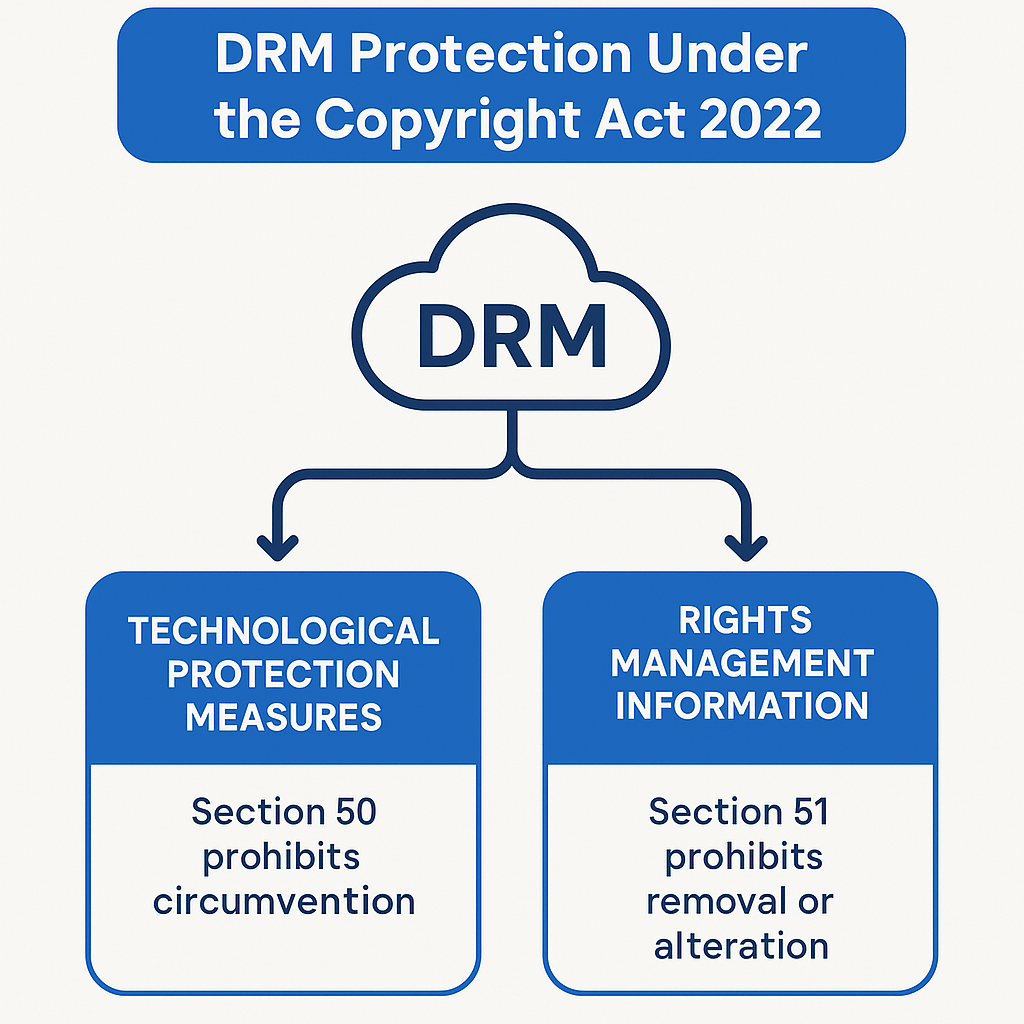
  4. Protection of Digital Rights Management and Rights Management Information: Section 50 prohibits the circumvention of technological protection measures used by rights holders to prevent unauthorized access to or copying of copyrighted works. Section 51 also makes it unlawful to remove, alter, or falsify rights management information, which includes metadata embedded in digital content that identifies the creator, copyright owner, and licensing conditions. While section 52 provides legal remedies for the circumvention of TPMs and the tampering with RMI.

In essence, DRM = Legal and technical tools (like encryption, watermarks, or access controls) used to protect digital content from unauthorized use. Under the Copyright Act 2022, these protections are enforceable in form of civil or criminal penalties in event of infringements.

These provisions give creators the tools to actively monitor, intercept, and respond to unauthorized uses of their music across digital platforms.

The Synergy of Visibility and Legal Protection

The combination of increased visibility through streaming platforms and robust legal protection under the Copyright Act 2022 empowers creative practitioners leverage their online presence to build their brand, attract opportunities, and secure fair compensation for their work, knowing that currency is certain when creativity is backed by code.

Looking Ahead: Embracing Innovation

The digital landscape continues to evolve, with emerging technologies like AI, blockchain, and Augmented Reality/Virtual Reality poised to further transform the creative industries. Creators should remain adaptable and explore these new tools and platforms to enhance their creativity and connect with audiences in innovative ways. Similarly, legislations and regulations should encourage innovation around these technologies providing the necessary legal framework.

Final Note: Empowering Your Creative Journey

The digital era offers immense potential for creative practitioners. Understanding the dynamics of streaming platforms and leveraging the protections afforded by the Copyright Act 2022, allows creators navigate digital environment effectively, maximize their visibility, and secure their rightful place in the global creative economy.

Recommendations for Indie Artists:

  1. Develop your knowledge on the law and regulation by signing up for webinars and/or attend masterclasses that provides you with insight on your rights and responsibility based on the provisions of the Copyright Act 2022.
  1. Utilize Platform Tools: Leverage the data and analytics tools provided by streaming platforms to optimize your content strategy and audience engagement.
  2. Protect Your IP: Take proactive steps to protect your intellectual property, including registering your works at the trademark registry and the Nigerian Copyright Commission. Also employ the service of a lawyer to conduct brand watch and monitor infringement. Consulting legal professional specializing in intellectual property to ensure your rights are protected while navigating complex licensing agreements.
  3. Engage with the Community: Connect with other creators and industry professionals to share knowledge, collaborate, and stay informed about emerging trends

Written by Adeola Osifeko LLB,BL,LLM, ACIS, ABR. Partner, Corporate Commercial Practice.

Reimagining Capital Markets: The Investment and Securities Act 2025 and the New FinTech Landscape in Nigeria.

Introduction

The enactment of the Investment and Securities Act 2025 (ISA 2025) by President Bola Ahmed Tinubu marks a transformative moment for Nigeria’s capital markets. Repealing the long-standing ISA 2007, the new legislation introduces pivotal reforms that align the country’s regulatory environment with emerging digital realities. ISA 2025 modernizes the statutory framework to accommodate innovation in the financial sector, with particular emphasis on digital finance, financial inclusion, and global compliance.

This article outlines the major highlights of the new Act, especially as they affect Nigeria’s rapidly expanding FinTech ecosystem.

1. Expanding SEC’s Mandate to Embrace Financial Innovation

A cornerstone of ISA 2025 is the significant enhancement of the Securities and Exchange Commission’s (SEC) regulatory powers. The Act now grants the SEC comprehensive authority over Virtual Asset Service Providers (VASPs) and Digital Investment and Savings Platforms (DISPs)—bringing regulatory clarity to previously ambiguous areas of digital finance.

Prior to the enactment, operators such as Piggyvest, Cowrywise, Trove, and Bamboo functioned in regulatory grey zones. ISA 2025 now codifies these operations, empowering SEC to issue licenses, supervise conduct, and enforce compliance. This development not only strengthens consumer protection, but also gives legitimacy to tech-driven savings and investment platforms.

2. Legal Recognition of Digital Assets and VASPs.

In line with international best practices—including standards set by the Financial Action Task Force (FATF)—ISA 2025 explicitly classifies virtual assets as securities. Entities that exchange, store, or facilitate transactions involving digital assets must now register with the SEC.

This regulatory clarity resolves previous jurisdictional overlaps between the Central Bank of Nigeria (CBN) and the SEC. While the CBN retains authority over payment systems and monetary policy (such as eNaira or stablecoins), the SEC now oversees capital market functions involving blockchain-based tokens, tokenized securities, and crypto investment schemes.

3. Introduction of Digital Investment and Savings Platforms (DISPs)

Recognizing the growing role of mobile-based investing, ISA 2025 formally introduces Digital Investment and Savings Platforms (DISPs) as a regulated category. DISPs are platforms that facilitate access to fractional investments, curated portfolios, or savings plans using technology.

The Act mandates strict operational standards for DISPs, including:

  • Investor suitability checks
  • Disclosure obligations
  • Custodial safeguards
  • Anti-fraud protections

Startups like Risevest now have a defined compliance path, promoting investor confidence and strengthening institutional trust in app-based investment channels.

4. Classification of Securities Exchanges for Market Segmentation

ISA 2025 introduces new categories of securities exchanges under Section 273, distinguishing between:

  • Composite Exchanges – for listing and trading all types of securities
  • Non-composite Exchanges – for specialized markets (e.g., commodities, derivatives)

This segmentation promotes specialization and clearer oversight, encouraging innovation in niche investment markets such as commodities and digital asset trading.

5. Investor Protection Fund Extended to Digital Platforms

A major boost for investor confidence is the extension of the Investor Protection Fund (IPF) to cover clients of VASPs and DISPs. The SEC can now guarantee compensation for investors who suffer losses due to fraud or misconduct by licensed digital operators.

The use of Legal Entity Identifiers (LEIs) is also mandated under ISA 2025, ensuring accountability for all entities engaged in market activities and enabling seamless integration with global financial systems.

6. Criminalization of Ponzi Schemes and Unregulated Investment Operators

In direct response to Nigeria’s surge in fraudulent investment schemes, ISA 2025 explicitly criminalizes Ponzi operations, imposing severe penalties for those promoting illegal schemes.

According to the Director-General of the Securities Exchange Commission, this provision enables the Commission to “come against bad operators in the industry and ensure that people are more confident and happier to invest in the Nigerian market,” with an enhanced investor protection mandate.


7. Surveillance and Enforcement Modernized for Digital Markets

ISA 2025 significantly upgrades the SEC’s powers to investigate and prosecute digital market misconduct. New enforcement tools include:

  • Digital surveillance systems
  • Asset freezing powers
  • Prosecution of market manipulation in token trading

These updates ensure that activities like fake trade volumes, insider trading involving digital assets, and pump-and-dump schemes fall squarely within SEC’s enforcement reach.

8. Regulatory Sandboxes and Support for Innovation

A notable innovation is the SEC’s authority to implement regulatory sandboxes, graduated compliance models, and incubation support for early-stage startups. This is especially important for FinTechs targeting underserved populations and informal sectors.

For example, ISA 2025 formally recognizes informal community-based schemes such as Esusu, integrating them into Nigeria’s capital market framework.

9. Global Alignment: Competing on a World Stage

By recognizing digital assets and standardizing VASP registration, Nigeria joins progressive jurisdictions such as:

  • South Africa (via FSCA licensing of crypto operators)
  • Singapore (under the MAS Payment Services Act)
  • United Kingdom (with FCA registration requirements for digital custodians)

This alignment positions Nigeria as a hub for venture capital, blockchain infrastructure, and international FinTech partnerships.

Conclusion: A New Era of Inclusive, Technology-Driven Investment

The Investment and Securities Act 2025 is more than just legislative reform—it is a strategic framework for innovation, transparency, and investor protection in the digital age. For Nigeria’s FinTech community, the Act brings long-awaited clarity and opportunity, enabling them to operate with legal certainty, scale sustainably, and access new forms of capital.

At AEO Law Practice, we welcome these developments as an essential tool for next-generation investing. We are committed to supporting our clients—including startups, investors, and institutional stakeholders—with regulatory compliance, structuring, and legal advisory.

To help businesses take advantage of these changes, we are launching a Business Intelligence Resource Stack—a curated legal and compliance toolkit for VASPs, DISPs, blockchain-based finance providers, and startups entering the regulated investment space.

Interested? Send an email with the caption “Business Intelligence Resource Stack” to info@aeolawpractice.com and we’ll be happy to share!

Adeola Osifeko LLB, LLM, ACIS, ABR
Partner, AEO Law Practice
Corporate Commercial | Regulatory & Compliance Practice Group
www.aeolawpractice.com